Galaxy Task Management with Celery
Learning Questions
How does Galaxy handle long-running tasks?
When should I use Celery?
How do I create a new Galaxy task?
Learning Objectives
Understand when to use tasks vs web requests
Learn how to declare Celery tasks
Use Pydantic for task serialization
Understand best practices
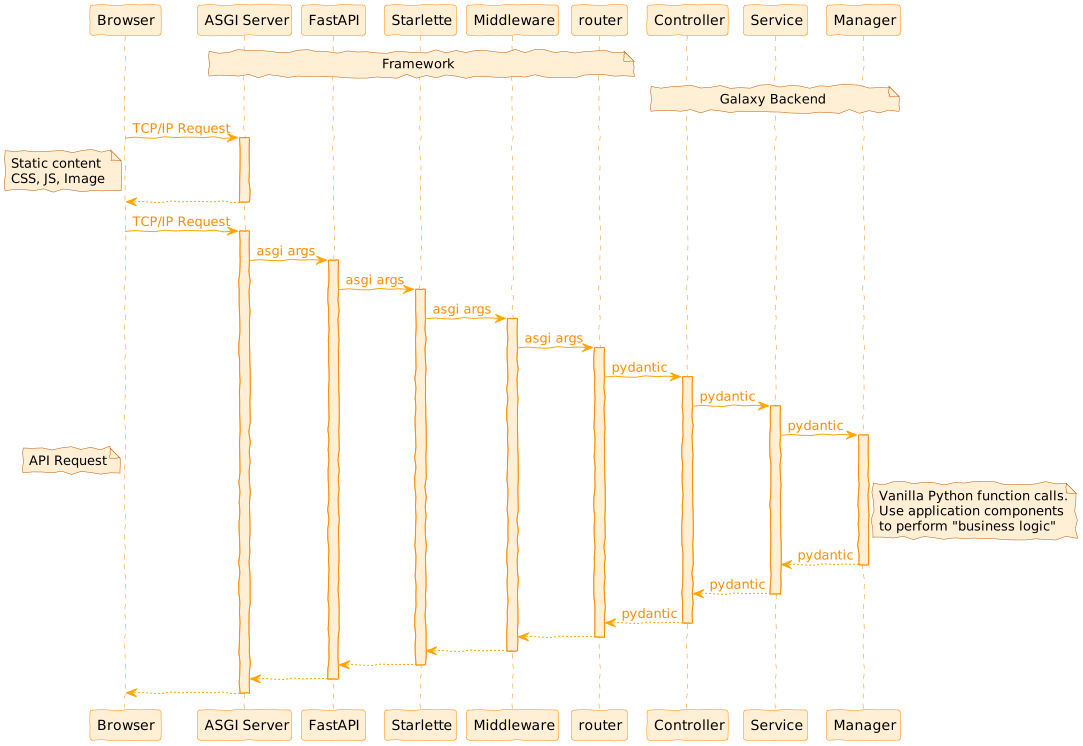
Avoid Doing Work in Web Threads
Web servers are a terrible place to do work. Traditional Python WSGI servers are meant for processing requests that take less a minute - they are meant for long running tasks.
This request/response cycle is inappropriate for deleting all the files in a history, submitted 10,000 batch jobs for a collection, building a zip file for a library folder.
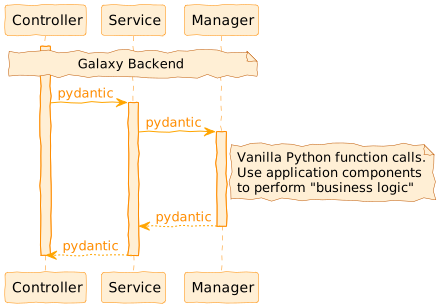
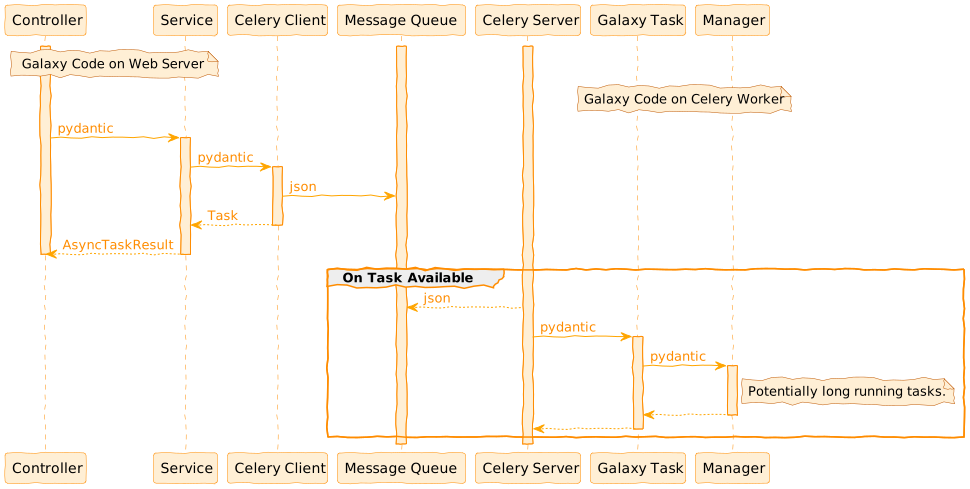
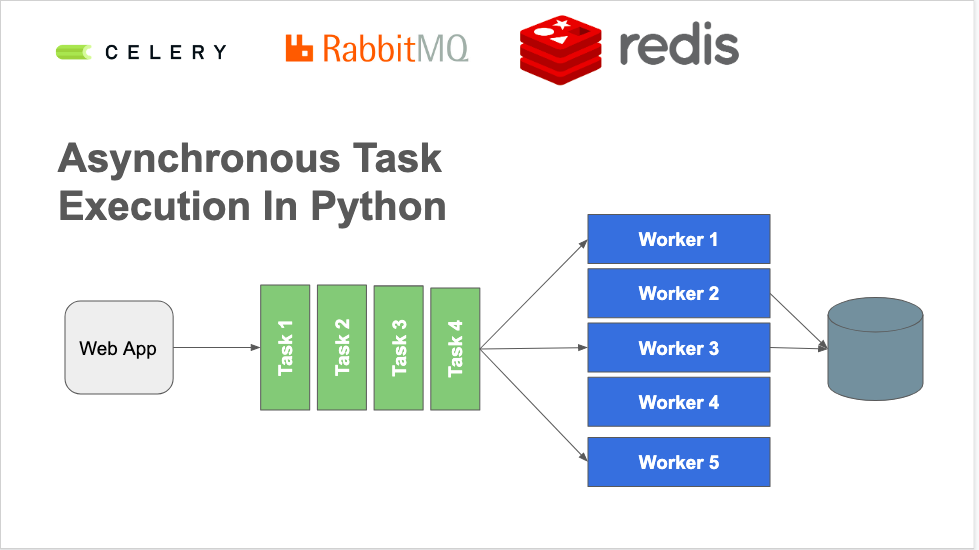
Downsides of Celery
Adds more complexity to deploying Galaxy. Celery needs to be available to Galaxy at runtime, production Galaxy instances need a broker and a backend.
Gravity + Celery
$ galaxy
Registered galaxy config: /home/nate/work/galaxy/config/galaxy.yml
Creating or updating service gunicorn
Creating or updating service celery
Creating or updating service celery-beat
celery: added process group
2022-01-20 14:44:24,619 INFO spawned: 'celery' with pid 291651
celery-beat: added process group
2022-01-20 14:44:24,620 INFO spawned: 'celery-beat' with pid 291652
gunicorn: added process group
2022-01-20 14:44:24,622 INFO spawned: 'gunicorn' with pid 291653
celery                           STARTING
celery-beat                      STARTING
gunicorn                         STARTING
==> /home/nate/work/galaxy/database/gravity/log/gunicorn.log <==
...log output follows...
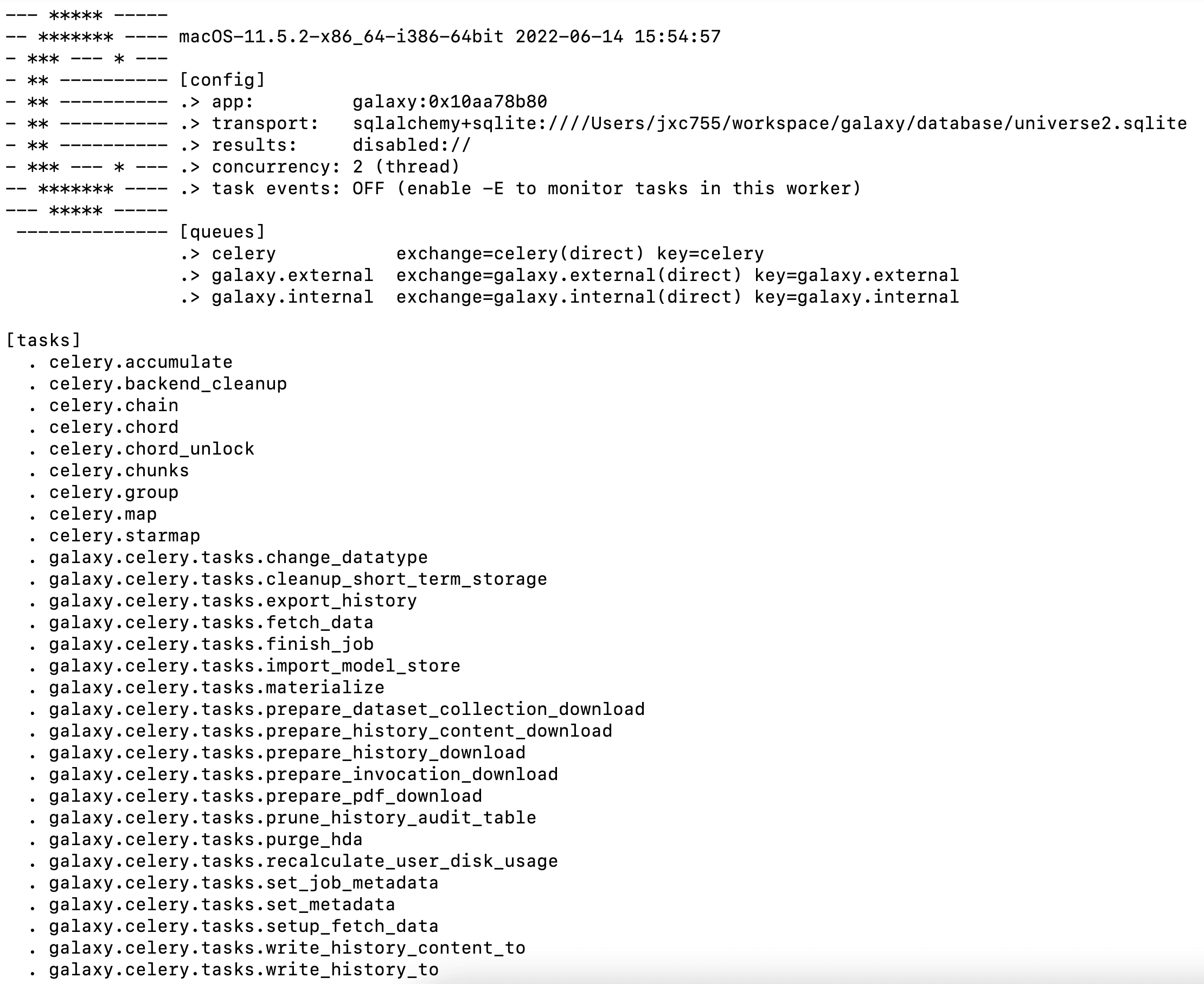
Declaring a Task
Placed in
galaxy.celery.tasks.We’ve placed a layer around Celery to mirror what we’re with API endpoints.
Typed functions with Pydantic inputs implicitly mapped.
Implicit type based dependency injection from Galaxy’s DI container (using Lagom)
Feels a lot like writing an API endpoint.
A Simple Task
@galaxy_task(
    ignore_result=True,
    action="setting up export history job"
)
def export_history(
    model_store_manager: ModelStoreManager,
    request: SetupHistoryExportJob,
):
    model_store_manager.setup_history_export_job(request)
The galaxy_task Decorator
@galaxy_task(
    ignore_result=True,
    action="setting up export history job"
)
def export_history(
    model_store_manager: ModelStoreManager,
    request: SetupHistoryExportJob,
):
    model_store_manager.setup_history_export_job(request)
galaxy_taskis a wrapper around Celery’staskdecoratorWrap a simple function to turn it into a task.
Ensure all inputs are JSON serializable or components in Galaxy’s dependency injection container
Celery and Pydantic
The request argument to export_history is a Pydantic model type named
SetupHistoryExportJob. These are mostly defined in galaxy.schema.tasks.
from pydantic import BaseModel

class SetupHistoryExportJob(BaseModel):
    history_id: int
    job_id: int
    store_directory: str
    include_files: bool
    include_hidden: bool
    include_deleted: bool
Celery and Pydantic - Implementation
Custom JSON encoding and decoding to adapt Celery to Pydantic.
Implemented in
galaxy.celery._serialization.Inject
__type__and__class__attributes into JSON description.@galaxy_taskdecorator sets Celeryserializerattribute.
Celery and Dependency Injection
@galaxy_task(
    ignore_result=True,
    action="setting up export history job"
)
def export_history(
    model_store_manager: ModelStoreManager,
    request: SetupHistoryExportJob,
):
    model_store_manager.setup_history_export_job(request)
The type declaration on
model_store_managerofModelStoreManagercauses the Galaxy manager object of this class to be passed to the function when the task is running.Client does not need to have any knowledge of this class.
Executing Tasks from Galaxy
See lib/galaxy/tools/imp_exp/__init__.py:
from galaxy.schema.tasks import SetupHistoryExportJob

...

    request = SetupHistoryExportJob(
        history_id=history.id,
        job_id=self.job_id,
        store_directory=store_directory,
        include_files=True,
        include_hidden=include_hidden,
        include_deleted=include_deleted,
    )
    export_history.delay(request=request)
The delay method is created implicitly from the galaxy_task decorator.
Best Practices
Place tasks in
galaxy.celery.tasks.Keep the tasks as thin as possible (ideally simply delegate inputs to a manager or another Galaxy component independent of Celery).
Ensure required/injected Galaxy components as small and decomposed as possible.
Place new request definition argument types in
galaxy.schema.tasks.
Existing Tasks Success Stories
PDF Export Problems
We added PDF export of Galaxy Markdown using weasyprint
Generation of PDF took too long, feature was quite unstable
Short Term Storage (STS)
A Galaxy component for managing user downloadable files that only need to exist for a little time.
Traditionally, these kind of files have required a lot of hacking to do well in Galaxy (tracking transient request-like stuff in data model, etc..)
Not just unoptimized by default, but unusable
Required customizing nginx routes, special web server plugins, etc…
https://github.com/galaxyproject/galaxy/pull/13691
class GeneratePdfDownload(BaseModel):
    short_term_storage_request_id: str
    basic_markdown: str
    document_type: PdfDocumentType
Robust PDF Export
from galaxy.managers.markdown_util import generate_branded_pdf

@galaxy_task(
    action="preparing Galaxy Markdown PDF for download"
)
def prepare_pdf_download(
    request: GeneratePdfDownload,
    config: GalaxyAppConfiguration,
    short_term_storage_monitor: ShortTermStorageMonitor,
):
    generate_branded_pdf(
        request,
        config,
        short_term_storage_monitor,
    )
Exporting Histories, Invocations, Libraries
@galaxy_task(
    action="generate and stage a workflow invocation store for download"
)
def prepare_invocation_download(
    model_store_manager: ModelStoreManager,
    request: GenerateInvocationDownload,
):
    model_store_manager.prepare_invocation_download(
        request
    )
Optimized Uploads
Decomposed job handling, precursor to migrating more job components to Celery
Converting uploads to tasks signficantly sped up running Galaxy tests
API tests went from 2.5 hours to 50 minutes
Amazing speed up for small jobs
Exploring task composition
Uploads - Task Composition
See lib/galaxy/tools/execute.py
async_result = (
    setup_fetch_data.s(job_id, raw_tool_source=raw_tool_source)
    | fetch_data.s(job_id=job_id).set(queue="galaxy.external")
    | set_job_metadata.s(
        extended_metadata_collection="extended" in tool.app.config.metadata_strategy,
        job_id=job_id,
    ).set(
        queue="galaxy.external",
        link_error=finish_job.si(job_id=job_id, raw_tool_source=raw_tool_source)
    )
    | finish_job.si(job_id=job_id, raw_tool_source=raw_tool_source)
)()
Batch Operations
Task-based operations enable the most expensive of the new history’s batch operations.
Changing datatypes
Purging datasets
Future Work
Migrating tool submission to tasks
Workflow scheduling
Importing shared histories
Key Takeaways
Web servers are inappropriate for long-running work
Celery handles async task execution
Gravity manages Celery processes
Tasks use typed functions with Pydantic
DI works in tasks just like controllers